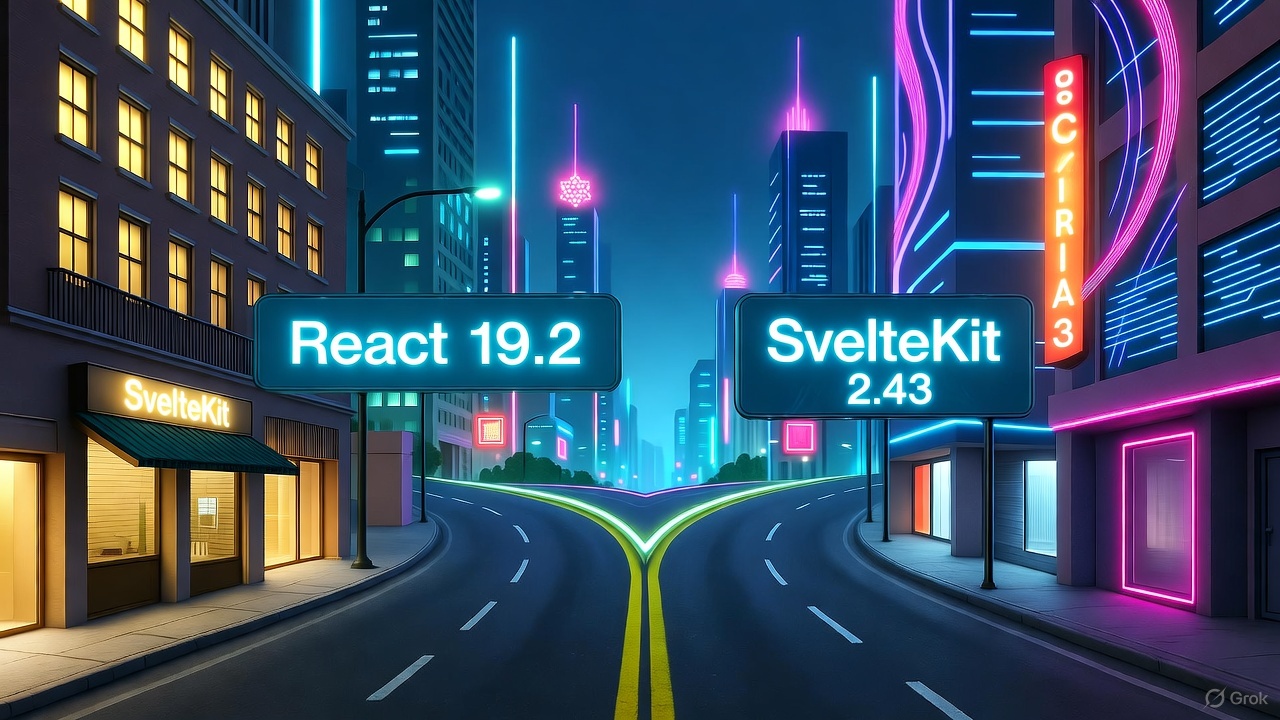
The battle lines are redrawn. With React unveiling version 19.2 and SvelteKit 2.43 bringing “await anywhere” and remote function capabilities, the question isn't just which framework — it's which paradigm. We’ll compare them side-by-side so you can decide which fits your next stack.
React 19.2: What It Brings
React 19.2 focused on refinements around concurrent rendering, hydration boundaries, and ecosystem scalability (e.g., streaming SSR, metadata APIs).
Strengths:
- Massive ecosystem, libraries, community support.
- Stability and enterprise readiness.
- Mature tools and patterns.
Weaknesses: - Weight: tooling and library baggage still present.
- Architectural inertia: might take more effort to adopt bleeding-edge patterns.
SvelteKit 2.43: What’s Shifting
SvelteKit 2.43 isn’t just faster — it re-thinks how you build.
Strengths:
- Async SSR (await in components) reduces boilerplate and tightens code.
- Remote functions + query.batch bring data closer to the component.
- Minimal runtime, smaller bundles, leaner hydration.
Weaknesses: - Newer ecosystem, smaller pool of third-party libraries.
- Experimental features may require caution.
- Might require mind-shift on team workflows.
Direct Comparison: Feature | React vs SvelteKit
| Feature | React 19.2 | SvelteKit 2.43 |
|---|---|---|
| Hydration & client-bootstrap | Improved lanes, concurrent updates | Minimal hydrate due to async SSR |
| Data-loading patterns | load() / hooks / SSR | Remote functions + await in components |
| Bundle size & runtime weight | Mature, but heavier | Extremely lean |
| Ecosystem & libraries | Vast, proven | Growing quickly |
| Stability & enterprise support | High | Emerging |
| Architectural shift | Iterative | Re-imaginative |
Which One Should You Choose?
- If you’re building a large-scale, team-based project, want lots of ready-to-go libraries, and prefer a conservative stack — lean React 19.2.
- If you’re building a fast-moving, performance-critical product, willing to pioneer new patterns, and care deeply about bundle size & hydration — explore SvelteKit 2.43.
- Hybrid approach: Consider a “framework of record” (React) for stable parts, and a “high-performance module” (SvelteKit) for edge/critical paths. So you mix the best of both worlds.
My Take: The Future Belongs to Async-First
We’re at the moment where how we build matters as much as what we build. React’s maturity matters, but SvelteKit’s architecture is showing us where the platform is headed.
If it were me: I’d pick React today, but I’d build a new module or green-field feature in SvelteKit. Get the knowledge, pay the debt early, so you’re ready when your next product demands lightning-fast performance.
Your role going forward? Not only a “frontend engineer” but a “render strategy engineer” — you’ll pick frameworks based on architectural fit, not hype.
Conclusion
React 19.2 and SvelteKit 2.43 both bring leaps — but they serve different missions. React continues to excel at scale, ecosystem and stability. SvelteKit shakes up the rules with async SSR and remote functions.
The real choice isn’t framework versus framework — it’s which stack gives you the right trade-offs for your product and team today, and scales for your goals tomorrow.
Pick wise. Build forwards. Stay ready.
Building frontend systems at scale for the past decade. Staff Engineer, occasional writer, and someone who still finds CSS genuinely interesting. Currently helping companies move fast without breaking their architecture.